Jail History
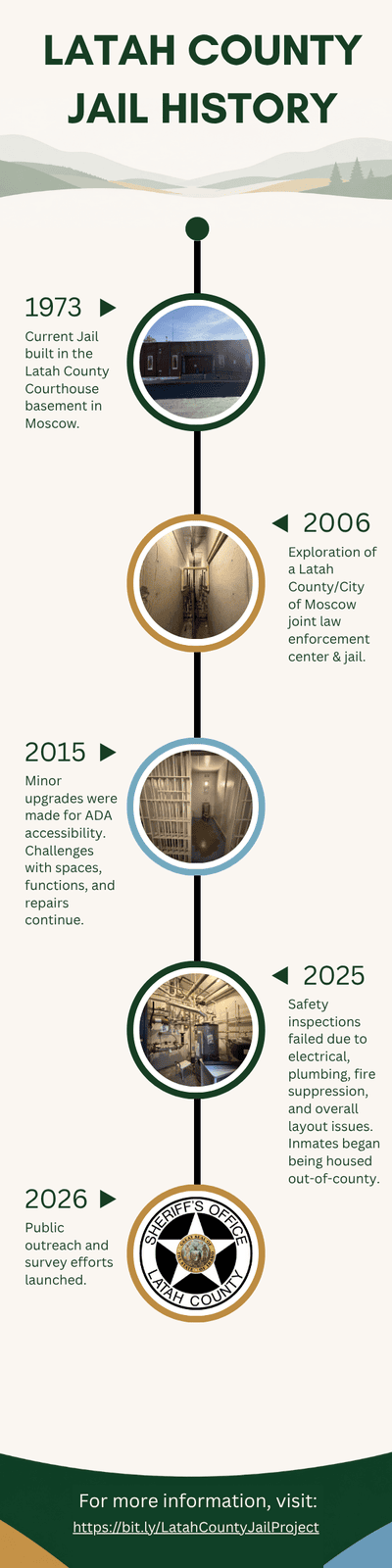
The current Latah County Jail was built in 1973, replacing the County’s 1927 jail and marking a major public investment in law enforcement and detention services. At the time, the new jail represented a modern improvement. It included features that were important for jail operations in that era, including a sally port, an attorney visiting room, and medical space.
Even so, some limitations appeared almost immediately. In a written evaluation prepared only months after the jail opened, the Sheriff identified functional problems that had already emerged, including a booking area that was too small for the needs of the facility. That early observation would become part of a much larger pattern. The 1973 jail was built for the standards, practices, and expectations of its time. Over the next 50 years, detention standards changed substantially, while the basic design of the facility remained largely the same.
Since 1973, the jail has not undergone a major remodel or expansion. The County has made standard repairs and maintenance over the years, along with some limited improvements. In the early 2000s, two gates were widened to improve accessibility, and portions of the fire suppression system were extended. A storage room was also converted for medical use. These improvements helped the County continue operating the jail, but they did not change the underlying design or solve the facility’s long-term limitations.
The jail’s basement location has made those limitations more difficult to address. Plumbing, electrical systems, gates, locks, cameras, fire-safety systems, and other building components have aged within a confined space that is difficult to repair. When systems failed, staff and maintenance personnel often had to make temporary fixes, fabricate solutions, or work around outdated equipment for which parts were no longer readily available. Over time, the facility became increasingly difficult to maintain as a safe and functional jail.
Concerns about the jail are not new. By the mid-1990s, Sheriff’s Office leadership was already discussing the need for a new facility. Chief Deputy Tim Besst, who began working for the Sheriff’s Office in 1994 and worked in the jail beginning in 1995, recalled that the jail commander at the time was already talking about a new facility because of the jail’s layout, age, and operational challenges.
The County made its most significant prior effort to pursue a new facility between 2006 and 2008. During that period, the County explored a combined law enforcement center with the City of Moscow. The project did not move forward, possibly due to concerns with funding and the recession.
After that effort ended, the County continued to maintain the existing jail as best it could. Staff adapted to the building, and the County avoided large capital expenses where possible. But maintenance could not correct the jail’s structural and operational problems. The building lacked sufficient space for booking, medical care, staff work areas, storage, attorney visits, inmate classification, and modern supervision practices. Many cells lacked natural light. Some cells were too small for the number of bunks they had historically held. Fire egress, fire suppression, smoke detection, plumbing, and electrical systems all became recurring concerns.
In 2018, the County’s insurance provider began taking a closer look at jail facilities across Idaho as part of its risk-management work. That process brought additional attention to the physical condition of the Latah County Jail. The concerns included electrical and plumbing systems, the camera system, fire egress, fire suppression, and the overall condition of the facility.
Local fire inspectors evaluated the Jail annually. From a local perspective, portions of the jail were “grandfathered” because the building predated current fire and life-safety standards. But that did not eliminate the County’s risk. If a serious incident occurred, federal standards and federal litigation would not necessarily treat grandfathering as a complete defense. In practical terms, the County could pass certain local inspections while still facing significant liability because the facility did not meet modern expectations for jail safety.
Inspection records and staff reports in recent years show the growing strain on the facility. In 2022, the Idaho Sheriffs’ Association jail inspection identified mandatory and recommended standards that were out of compliance, including issues related to cell size and inadequate space for booking, medical clinics, and administrative work areas. Some of those issues were corrected or managed in later inspections, but the underlying building limitations remained. By 2024 and 2025, the concerns had become more serious and more visible.
In 2024, fire inspections identified multiple deficiencies, including emergency lighting, smoke detection, sprinkler coverage, electrical concerns, storage issues, and fire-suppression issues. Staff also noted growing issues such as plumbing failures, worn locks and gates, inadequate staff workspace, lack of storage, cells without natural light, showers that did not drain properly, toilets and sinks that required frequent repair, and areas that created privacy and safety concerns for inmates and staff.
The County also obtained professional input from jail architects. After reviewing the facility, the architects concluded that the County should renovate to extend the life of the Jail, close the Jail, or build a new facility.
Major repairs to the fire suppression system, fire alarm system, camera system, and related safety equipment could help preserve insurance coverage for a period of time, but they would not solve the jail’s broader problems.
In 2025, the County decided to close the Jail for overnight housing. The County’s decision was the result of many overlapping factors: the age and deterioration of the facility, fire and life-safety concerns, insurance risk, staff and inmate safety, architectural evaluations, jail inspection findings, and the increasing cost of temporary repairs. The County determined that continuing to operate the jail as it had for decades was no longer sustainable.
The County is now evaluating potential solutions. Options include renovating the Jail, continue to send inmates to other county jails, partner with other counties for a regional facility, or build a new jail. To make this decision, the County is evaluating funding, local control, and community feedback in an effort to find a cost-effective and long-lasting solution.